What is the golden rule of Stoicism? A clear guide to virtue and practice
This article explains that rule, traces its roots in primary Roman Stoic texts, and shows how to turn the doctrine into short daily practices. It is meant for curious readers and students who want both a clear explanation and practical steps to apply Stoicism thoughtfully.
Definition: the golden rule at the heart of Stoicism
What Stoic ethic claims about the good
The Stoic golden rule can be stated simply: virtue, or arete, is the only intrinsic good and human life should be lived in agreement with nature, which together give Stoic ethics its evaluative center, as described in standard philosophical overviews.
That concise statement is not a modern gloss but a summary of classical doctrine grounded in primary and scholarly sources, and it is the working definition used by many teachers who reduce Stoic ethics to action-guiding principles Stanford Encyclopedia of Philosophy
Explore more on the Stoicism Blog
Try the four-item checklist later in this article as a short daily practice to make these ideas practical
Short, plain definition you can remember
In plain terms, the rule asks you to shape your will so it aims at virtuous choices and to accept what you cannot change, making moral worth depend on intention and judgment rather than on external success.
Readers who want the doctrinal basics are best served first by primary Roman Stoic writings, which preserve the practical phrasing and examples that convey this rule in action Meditations - Marcus Aurelius
Core Stoic principle: virtue and living according to nature
How the two parts of the rule connect
Stoic ethical theory pairs two claims that work together: the evaluative claim that virtue is the sole intrinsic good, and the normative claim that one should live according to nature, meaning to exercise reason and social capacities in accordance with human nature. Internet Encyclopedia of Philosophy
Explaining how these pieces fit requires recognizing that 'living according to nature' in Stoic usage points to the rational, social aspects of human life and so supplies a content for what virtue looks like in practice, an interpretation supported by modern philosophical summaries Stanford Encyclopedia of Philosophy
Why this counts as the 'golden rule' of Stoicism
Seen together, the two claims function like a golden rule because they give a single, unified standard for evaluating actions and intentions: act from reason and aim at moral excellence, and treat externals as indifferent relative to virtue.
Marcus Aurelius models this unity in short reflections that consistently return to virtue as the measure of the good and to right action as consonant with nature Meditations - Marcus Aurelius
What is under your control: prohairesis and practical choice
Prohairesis defined in one line
Prohairesis is the Stoic technical term for the faculty of choice that is truly under our control, roughly the intentions and judgments that shape responses to events.
Epictetus emphasizes this distinction as the practical hinge of Stoic ethics, advising constant attention to what belongs to our choice and what does not Enchiridion - Epictetus
Stoic ethics centers on the rule that virtue is the sole intrinsic good and that one should live according to nature; this becomes actionable by focusing on prohairesis, the part of choice under our control, and by using brief daily exercises to form virtuous habits.
How this distinction makes the rule practical
By narrowing moral responsibility to prohairesis, Stoics make the golden rule actionable: cultivate virtuous judgment where you have power and accept outcomes you do not control, which turns ethics into a daily discipline.
Epictetus uses examples of lost possessions and insults to show how focusing on prohairesis prevents wasted anger and preserves moral agency Enchiridion - Epictetus
Historical roots: Hellenistic origins and Roman Stoic texts
Who developed the doctrine and how it was transmitted
The Stoic rule originated with Hellenistic thinkers such as Zeno of Citium and Chrysippus and was transmitted and exemplified in Roman-era writings that we read today for doctrine and practice.
Because many founding Hellenistic texts are lost, readers rely on Roman Stoics as accessible windows into classical doctrine and technical terms preserved across centuries Stanford Encyclopedia of Philosophy and a recent review NDPR review
Which ancient texts writers should consult first
For direct access to practice and moral argument, begin with Marcus Aurelius's Meditations, Epictetus's Enchiridion and discourses, and Seneca's letters and essays, which together provide the clearest surviving exposition of Stoic moral teaching.
Translations of these works offer concrete examples and exercises and remain the best primary sources for anyone who wants to test the doctrinal summary against original passages Selected Letters - Seneca
Stoicism compared with the Christian Golden Rule
Key differences in moral focus
Unlike the reciprocity formulation found in Matthew 7:12, which frames interpersonal ethics in terms of treating others as you would like to be treated, the Stoic rule centers moral worth on inner virtue and rational self-governance.
The comparison highlights a difference in orientation: the Christian statement emphasizes reciprocity in social conduct while Stoic ethics prioritizes the character of the agent, a contrast visible in canonical sources Matthew 7:12 - New Testament
Stoicism BlogWhy Stoic ethics is inward-focused
Stoicism evaluates actions chiefly by the quality of intention and judgment because externals are treated as indifferent; moral praise and blame attach to choices within our control rather than to outcomes beyond it.
Modern overviews and primary texts show that this inward focus was a defining feature of classical Stoic moral thought Stanford Encyclopedia of Philosophy
Daily practice: simple Stoic exercises and a one-page checklist
Short routines recommended in modern Stoic practice
Contemporary Stoic teachers and organizations recommend short daily routines that trace back to ancient practices, such as morning intention-setting, premeditatio malorum or negative visualization, journaling, and occasional perspective exercises like the view from above.
Modern Stoicism as a practice community collects these exercises and presents them as accessible daily steps rooted in classical texts and contemporary pedagogy and on our Stoicism page Stoicism What is Stoicism? - Modern Stoicism
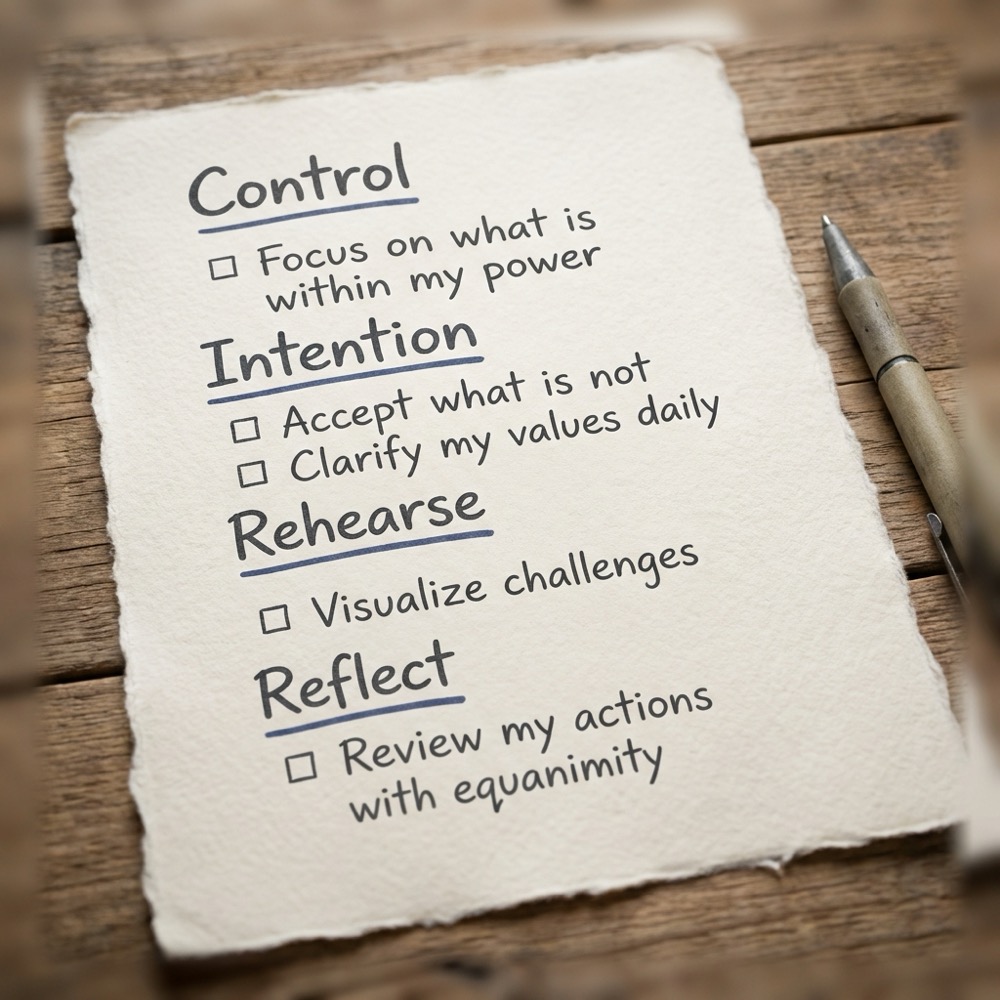
A one-page daily Stoic checklist to practice the golden rule
Copy or print this checklist for daily use
A four-item one-page checklist you can use today
Use these four items each day: 1) Clarify what is in your control, 2) Set a virtue-guided intention for the day, 3) Rehearse likely setbacks briefly, 4) Reflect on how you acted in the evening.
Practitioners build this simple page from both Epictetus' emphasis on control and modern routines that focus on short, repeatable tasks to create habit and clarity Enchiridion - Epictetus Also see our homepage LSW
A practical decision framework for applying the Stoic rule
Step-by-step decision flow you can use in the moment
When a choice arises, follow a short flow: identify the moral value at stake, determine what is under your control, choose the action consistent with virtue, then accept results beyond your power.
This procedural sequence turns the abstract golden rule into a repeatable decision method that links prohairesis to virtuous action Oxford Academic chapter
When to pause, when to act
Pause when the choice depends on externals you cannot control or when emotions obscure judgment; act promptly when a clear virtue-guided option is available and your intention aligns with reason.
Modern practice guides suggest brief pauses and written prompts to help preserve prohairesis in real time and to avoid reactive mistakes that betray virtue What is Stoicism? - Modern Stoicism
Common mistakes and pitfalls when practicing Stoicism
What people typically misunderstand
People often mistake Stoic acceptance for passivity, forget to distinguish acceptance from disengagement, or treat Stoic practice as emotional suppression rather than disciplined judgment about what one controls.
Contemporary teachers repeatedly caution against these misreads and offer corrective practices that preserve humane engagement while honoring Stoic priorities What is Stoicism? - Modern Stoicism
How to avoid turning practice into cold detachment
Use reflective journaling and social commitments as checks: write about emotional experiences to process them, and keep active responsibilities to others to ensure compassion remains central to virtue.
Primary texts and modern guides both emphasize that proper Stoic practice remains social and ethical rather than detached endurance Selected Letters - Seneca

Practical examples and scenarios: how the rule looks in life
Short vignettes applying the checklist
Work stress vignette: You receive a harsh critique at work. First, note that your response is under prohairesis; you can choose calm inquiry and correction rather than defensive anger. Set an intention to respond with clarity and to learn from any valid points.
This inner workflow mirrors Epictetus' advice to separate judgment from events and to act from reason rather than reactivity Enchiridion - Epictetus
Relationship tension vignette: A friend cancels plans last minute. Ask what is in your control, which is your reaction and how you communicate. Choose patience and a brief, honest message that reflects care and self-respect.
Marcus Aurelius often rehearses similar reframings in his journal, reminding himself that others act from their own judgments and that virtue is preserved by right response not by controlling others Meditations - Marcus Aurelius
Unexpected setback vignette: A sudden expense disrupts your plans. Focus on what you can do now, outline practical steps, and keep to your virtue-guided intentions, treating the external problem as neutral in moral worth.
Modern Stoic exercises encourage rehearsing setbacks briefly so you are mentally prepared and less likely to lose composure when difficulties arise What is Stoicism? - Modern Stoicism
Conclusion: living the golden rule of Stoicism today
Summary and realistic expectations
The Stoic golden rule centers virtue and living according to nature, and it becomes practical when paired with the control distinction, prohairesis, which directs attention to what we can govern.
Readers who want to deepen practice should consult primary texts and contemporary guides and our philosophy section while remembering that large-scale empirical evidence on long-term outcomes of Stoic routines is still limited What is Stoicism? - Modern Stoicism
The Stoic golden rule states that virtue is the only true good and you should live in agreement with nature, focusing on choices within your control.
Start with a short daily checklist: clarify what you control, set a virtue-guided intention, rehearse setbacks, and reflect in the evening.
There is growing practical and theoretical support for Stoic routines, but large-scale empirical studies measuring long-term outcomes remain limited.
References
- https://plato.stanford.edu/entries/stoicism/
- http://classics.mit.edu/Antoninus/meditations.html
- http://classics.mit.edu/Epictetus/epicench.html
- https://iep.utm.edu/stoiceth/
- http://classics.mit.edu/Seneca/letters.html
- https://www.biblegateway.com/passage/?search=Matthew+7%3A12&version=NIV
- https://luiswester.com/philosophy/stoicism/
- https://modernstoicism.com/what-is-stoicism/
- https://ndpr.nd.edu/reviews/learning-to-live-naturally-stoic-ethics-and-its-modern-significance/
- https://luiswester.com/philosophy/stoicism/
- https://luiswester.com/
- https://academic.oup.com/book/44871/chapter/384581587
- https://luiswester.com/philosophy/