What are the 4 rules of Stoicism? A practical, modern guide
The approach here is practical: you will get short definitions, classical and contemporary sources to follow up on, and simple exercises to try. The explanation draws on primary authors and on modern summaries and practice resources so you can see how ancient ideas map to modern routines Stanford Encyclopedia of Philosophy
Readers who want guided short exercises can look to organized practice communities and week-long experiments that standardise accessible routines for beginners and experienced practitioners alike ModernStoicism.org
What are the four rules of Stoicism? A plain definition and quick context
Stoicism can be usefully summarized as four operative rules: focus on what you control, make virtue the aim, rehearse setbacks with premeditatio malorum, and practise daily cognitive exercises to align action with reason. These points reflect both the classical sources and the way modern practice guides present Stoic techniques for daily use.
The four rules in one line each: 1) Attend only to what is within your control, 2) Prioritize the four cardinal virtues, 3) Use negative visualization to prepare for loss and change, 4) Keep a steady routine of reflection, journaling, and reframing.
The four practical rules are: focus on what you can control, make the four cardinal virtues the aim of action, rehearse setbacks with premeditatio malorum, and practise short daily cognitive exercises like journaling and reframing.
Contemporary summaries and reference entries help map these operative rules onto classical texts and practice communities for modern readers, so you can learn the core ideas and try short exercises with clear origins and guidance Stanford Encyclopedia of Philosophy and our Stoicism blog
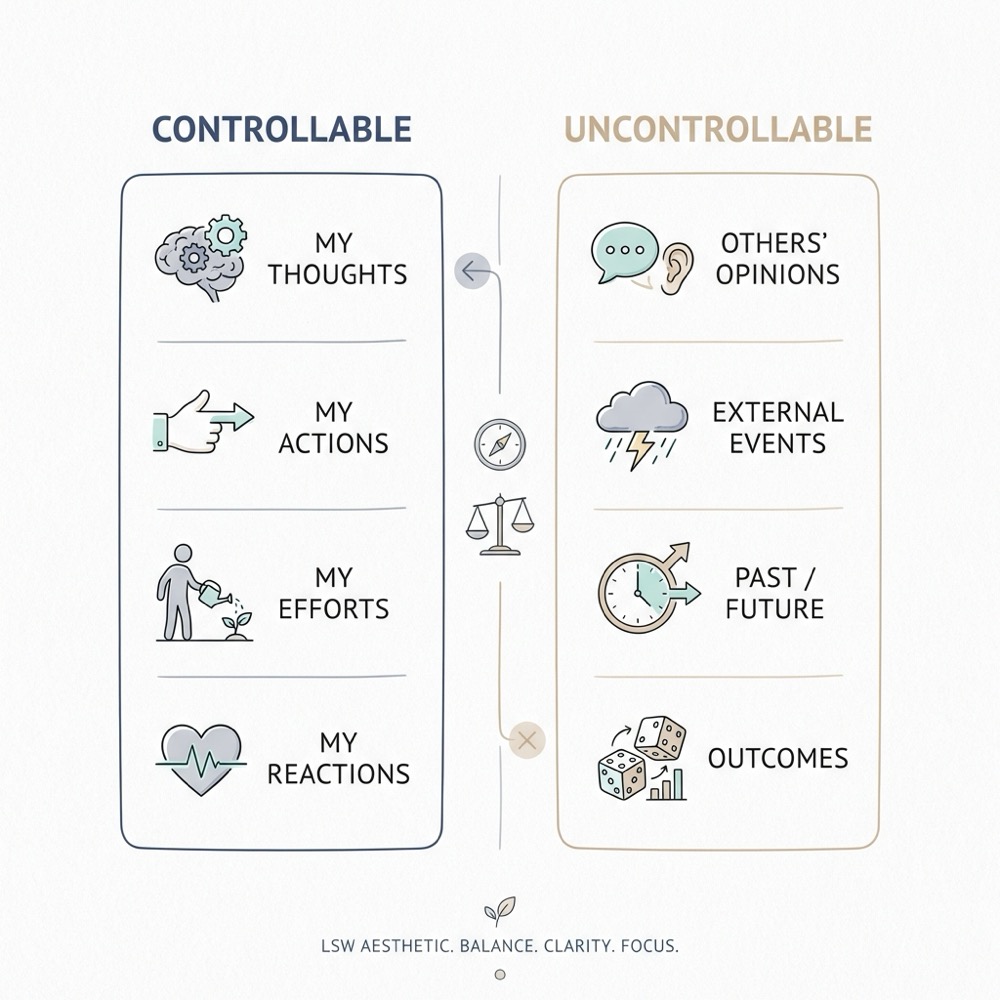
Rule 1: Attend to what is within your control (the dichotomy of control)
Stoicism centers attention on the difference between what you can influence and what you cannot, a principle most clearly stated by Epictetus in his handbook and paraphrases, where he invites a steady orientation toward one's own choices, judgments, and actions. This distinction helps reduce wasted effort on outcomes and directs energy to deliberate responses The Enchiridion
Practically, the dichotomy of control looks like a quick internal checklist: is this thing in my control, partly in my control, or outside it? Say you miss a deadline because a team member was late. You cannot control their choice, but you can control how you respond, communicate, and adjust plans. Framing the situation this way narrows your field of action and clarifies next steps.
Short exercises to build this focus include a one-minute pause before reacting, naming one controllable action you can take, and making that action the next step on your to-do list. Over time, this practice becomes a habit that reduces reactivity and improves planning, and modern summaries stress its central role in Stoic practice Stanford Encyclopedia of Philosophy
Rule 2: Make virtue the aim - wisdom, justice, courage, temperance
Stoicism places moral virtue, not external success, at the center of a good life; practitioners make the four cardinal virtues into decision criteria for everyday choices. Wisdom guides judgment, justice orients social action, courage supports facing difficulties, and temperance helps with restraint; together they form a simple rubric for deciding what to do when results are uncertain Internet Encyclopedia of Philosophy
Example: at work, wisdom may mean pausing to gather facts before replying, justice may mean giving credit where it is due, courage may mean raising a difficult issue calmly, and temperance may mean refusing to escalate a conflict for short-term advantage. Framing choices in this way shifts the measure of success away from outcomes and toward character.
Try a One-Week Virtue Micro-Challenge
Try a one-week micro-challenge: each day pick one cardinal virtue and notice one action that expressed it; keep notes of small examples.
When you treat virtue as the aim, everyday tasks become ethical practice rather than mere instrumentality, and that shift underpins classical Stoic accounts of what truly matters in life Stanford Encyclopedia of Philosophy
Rule 3: Use anticipatory techniques such as premeditatio malorum to build resilience
Premeditatio malorum, or negative visualization, is a Stoic exercise that asks you to imagine plausible setbacks or losses in order to reduce surprise and steady emotion when difficulties occur; Marcus Aurelius uses forms of this practice in his Meditations as a way to prepare the mind for change Meditations
To practise safely, keep exercises short and specific: imagine a minor inconvenience or a realistic loss for two to three minutes, notice the feelings that arise, then name a practical response you could take. Avoid prolonged rumination by setting a clear time limit and ending with an action plan or a grounding activity.
Variants include listing temporary losses you can tolerate, mentally rehearsing how you would respond to a setback, or briefly writing a note about what truly matters if plans change. Modern practice guides use these standardized short exercises as accessible ways to build emotional resilience over time ModernStoicism.org
Rule 4: Apply cognitive reframing and daily exercises - journaling, reflection, rehearsal
Daily cognitive exercises are a practical core of Stoic habit formation: morning reflection, examining impressions during the day, and evening journaling are traditional techniques that help align choices with reason and the virtues. These routines map well onto modern cognitive methods that examine beliefs and rehearse responses Stoicism and cognitive-behavioural therapy
A simple 10-minute routine might include a brief morning note on intentions, a midday check of one impression you noticed and how you responded, and an evening two-minute journal entry about one action you can improve. The goal is not perfection but steady alignment of action and judgement through short, repeatable habits.
Stoicism BlogCommon short practices include examining an upsetting impression to find any unhelpful assumptions, reframing the view to what is useful and within your power, and rehearsing a calm response. Over time these small exercises change how you interpret events and what you choose to do in them.
How to choose and adapt Stoic rules for your situation
Choosing which Stoic techniques to try starts with your immediate need: if you feel stuck and reactive, begin with the dichotomy of control; if you want to shape your character, start a virtue micro-challenge; if anxiety is prominent, try brief negative visualizations. Adapting practices makes them sustainable and culturally appropriate, and contemporary practice communities provide varied templates you can modify ModernStoicism.org
Use a simple decision flow: identify the problem, pick the Stoic rule that targets the problem, try a short exercise for one week, record effects, and adjust. This measured approach respects the current research picture, which links Stoic techniques to cognitive methods but notes that experimental work isolating Stoic-only protocols is still developing Stoicism and cognitive-behavioural therapy and Modern Stoicism research.
Common mistakes and pitfalls when practicing Stoicism
A common misunderstanding is equating Stoic practice with emotional suppression; genuine Stoic training works with impressions and judgments rather than denying feeling, and modern guides warn against using Stoic labels to justify avoidance of care or empathy ModernStoicism.org
Another pitfall is applying techniques mechanically without reflecting on their purpose. For example, journaling without asking how entries connect to choices can turn a useful habit into empty routine. Instead, pair exercises with a short note on intention and a precise action to try next time.
A short tracking checklist to catch common practice errors
Use daily, optional reflection
Finally, cultural fit matters: adapt language and examples so exercises make sense in your context. Practice communities offer templates, but the underlying aim is steady improvement rather than rigid imitation, so personalise prompts and timing.
Practical examples and quick routines to try this week
Morning 5-minute routine: set one intention tied to a virtue, imagine one small obstacle and how you will respond, and write a single line of purpose. This short start anchors the day and makes decisions easier when distractions occur ModernStoicism.org
Midday 3-minute check: pause, name one impression that influenced your mood, ask whether it is within your control, and choose one small corrective step. These micro-checks interrupt automatic reactivity and keep practice practical.

Evening 10-minute journaling: note what you did, where your judgement matched a virtue, one mistake to correct, and one small concrete step for tomorrow. Recording effects for a week gives a simple feedback loop to see what helps and what to adapt.
Scenario 1, work stress: if an unexpected task arrives, use the dichotomy of control to decide what you can take on, apply temperance to avoid overcommitting, and end the day with a short note on one useful adjustment.
Scenario 2, relationship disappointment: use negative visualization to prepare for common frictions, practise courage to speak directly and calmly, and use evening reflection to align future responses with justice and wisdom.
Conclusion: Bringing the four rules together as a simple practice framework
These four rules work together: focusing on control narrows your actions, virtue guides what counts as right action, negative visualization readies you for change, and daily cognitive exercises turn intentions into habits. Read the classical passages and try short, structured experiments to see what fits your life Stanford Encyclopedia of Philosophy and our philosophy section
If you want a structured entry point, practice communities like Stoic Week provide organized short exercises that can help you test these rules for a week and record effects; keep expectations modest and focus on steady practice rather than instant change ModernStoicism.org and visit the Luis Wester site
Start with these four: the dichotomy of control, the four cardinal virtues, premeditatio malorum, and short daily exercises like journaling and reflection.
No, Stoic practice focuses on examining impressions and judgments; it aims to understand and respond to emotion, not to deny or suppress feeling.
Stoic techniques overlap with cognitive approaches but are not a substitute for professional therapy when clinical support is needed; they can complement therapeutic work.
References
- https://plato.stanford.edu/entries/stoicism/
- http://classics.mit.edu/Epictetus/epicench.html
- https://luiswester.com/philosophy/stoicism/
- https://iep.utm.edu/stoicism/
- https://www.gutenberg.org/ebooks/2680
- https://modernstoicism.com/stoic-week-2024-results-and-report-by-tim-lebon/
- https://modernstoicism.com/research/
- https://modernstoicism.com/stoic-week/
- https://luiswester.com/
- https://luiswester.com/philosophy/
- https://luiswester.com/philosophy/stoicism/
- https://modernstoicism.com/what-is-stoicism/